
Welcome
At Thrive Mind Health & Holistic, we believe mental wellness is more than symptom relief. It is the restoration of balance, connection, vitality, and a deeper sense of safety within the body.
Reiki is a gentle, non-invasive energy healing practice that supports the nervous system, helps the body settle into a restorative state, and creates space for emotional, physical, and spiritual balance. Whether you think of it as energy, life force, or simply the felt sense that something is ‘off,’ Reiki offers a supportive way to reconnect with yourself.
-
Reiki is a Japanese energy healing practice in which a trained practitioner channels universal life force energy to support the body’s natural ability to heal. Sessions are gentle, non-invasive, and performed fully clothed, with the practitioner placing their hands lightly on or just above the body.
-
Reiki may be supportive for people experiencing anxiety, depression, chronic stress, emotional exhaustion, grief, burnout, major life transitions, or those already in therapy who want to deepen somatic and energetic healing alongside their work. It can also be especially supportive for clients receiving ketamine-assisted therapy who are seeking grounding and integration support.
A Medical View
From a nervous system perspective, Reiki may help the body shift out of a chronic stress response and into a calmer, more regulated state. Like breathwork, meditation, massage, and time in nature, Reiki can support parasympathetic activation, the part of the nervous system associated with rest, repair, and safety. For clients experiencing anxiety, trauma, burnout, or emotional exhaustion, this gentle somatic support can be a meaningful complement to therapy and other forms of care.
-
Reiki sessions teach us and our bodies how to gain and sustain greater access to the calm state, similar to other practices that affect this part of the nervous system (e.g. massage, breathwork training, meditation, pleasant nature exposure)
Major hospital systems including the Cleveland Clinic and Johns Hopkins now offer Reiki as part of their integrative care programs, reflecting a growing recognition of its value alongside conventional treatment.
Reiki may offer meaningful support for:
Anxiety, Trauma, Chronic Stress
Reiki cultivates greater awareness of both the sympathetic ("fight-or-flight") and parasympathetic ("rest-and-digest") branches of the nervous system, helping you recognize how stress, emotions, and past experiences are held within the body. As awareness deepens, many people begin to notice patterns of tension, protective responses, and areas that may have gone unnoticed for years.
-
This increased body awareness often creates a greater sense of ease, safety, and curiosity, making it possible to approach experiences that once felt overwhelming with more presence and resilience. For many individuals, Reiki also complements psychotherapy by helping integrate insights from talk therapy on a deeper mind-body level, allowing emotional processing to feel more embodied rather than purely intellectual.
Depression, Burnout, Emotional Exhaustion
By restoring your energetic connection to your body, the present moment, and teaching you how to attune rather than resist environmental stimulation/energy, Reiki helps you overcome emotional exhaustion, flatness and the sense of disconnection that accompanies chronic stress.
Sleep Disturbances
Raising energy awareness and intelligence allows for greater skill in calming your mind and body, which can significantly improve sleep quality.

Reiki as a Complement to Your Healing Journey
At Thrive Mind Health & Holistic, we don’t believe any single modality holds all the answers. Healing is rarely linear, and it rarely happens in just one room. Reiki is most powerful when woven into a broader, personalized approach to care — and it integrates beautifully with every branch of our practice.
Reiki + Ketamine-Assisted Therapy
Ketamine therapy can open profound psychological windows — surfacing buried emotions, dissolving habitual patterns of thought, and creating a unique state of neuroplasticity. Reiki before or after a ketamine session helps the nervous system settle, supports the integration of insights, and provides a grounding, nurturing container for what can sometimes be an intense experience. For clients processing difficult material during integration, Reiki offers a gentle, wordless form of support that can reach places talk alone cannot.
Reiki + Ayurveda
Ayurveda and Reiki are natural partners — both rooted in the understanding that health is a dynamic balance of energy, and that imbalance precedes illness. Where Ayurveda addresses constitution, diet, herbs, and lifestyle, Reiki works directly with the subtle energy body. Together they offer a comprehensive approach to restoring balance at every level: physical, emotional, and spiritual.
Reiki + Talk Therapy
Talk therapy builds self-awareness and equips clients with tools for navigating their inner world. Reiki goes deeper into the body, releasing what words sometimes cannot reach. Many clients find that regular Reiki sessions help them arrive at therapy feeling more open, grounded, and better able to access difficult emotions. The two modalities work beautifully in tandem — one through language and insight, the other through presence and energy.
Reiki + Mindfulness & Meditation
Reiki naturally cultivates the same qualities that meditation develops — present-moment awareness, inner stillness, and a compassionate relationship with oneself. The two practices reinforce each other powerfully, and many clients find that regular Reiki deepens their meditation practice and vice versa.
-
Healing rarely happens in a straight line — and it rarely happens in just one room. At Thrive Mind Health & Holistic, we believe in meeting you with every tool we have: the clinical, the ancient, the somatic, and the spiritual. Reiki is one of the most gentle and profound of those tools, and we would be honored to share it with you.
-
Reiki was developed in early 20th-century Japan by Mikao Usui, a spiritual teacher who, following a period of deep meditation on Mount Kurama in 1922, received the symbols and attunements that form the foundation of the practice. Usui went on to train thousands of students, establishing a living lineage that has carried his teachings across the world and across generations.

What to Expect
If you’ve never experienced Reiki before, here is what a typical session at Thrive Mind Health & Holistic looks like:
Energy by Another Name — A Global Tradition
The concept of life force energy is not unique to Japan. Across thousands of years and dozens of cultures, humans have arrived at the same fundamental recognition: that we are more than our physical bodies, and that an invisible yet palpable force animates and sustains us. Reiki is one language for something the whole world has always known.
“If you have ever felt a room change when someone walked in, sensed that a friend was struggling before they said a word, or felt inexplicably restored after time in nature — you have already experienced energy. It simply may not have had a name.”
The table below reflects just how universal this understanding truly is.
Whether your background is rooted in Ayurveda, Chinese medicine, indigenous tradition, or no spiritual framework at all, the experience of energy is something you already carry. Reiki simply offers a structured, practiced way of working with it.
Culture / Tradition |
Name |
Context |
|---|---|---|
| Japanese (Reiki, Shinto) | Ki | Universal life force channeled in Reiki healing |
| Chinese (TCM, Qigong, Tai Chi) | Qi / Chi | Vital energy flowing through meridians; basis of acupuncture |
| Indian (Ayurveda, Yoga) | Prana | Breath and life force; central to pranayama and Ayurvedic medicine |
| Hawaiian (Huna tradition) | Mana | Spiritual power and presence |
| Hebrew / Jewish mysticism | Ruach | Breath, wind, spirit |
| Ancient Greek medicine | Pneuma | Vital spirit animating the body |
| Tibetan Buddhism | Lung | Wind energy; central to Tibetan healing practices |
| Ancient Egyptian tradition | Ka | The vital essence or double of the soul |
| Indigenous / Lakota tradition | Wakan | Sacred power present in all living things |
| Christian mysticism | Spiritus | Divine breath; the animating spirit |
The Chakra System and Reiki
Reiki practitioners work with the chakras as a living map of the body’s energy centers. The word chakra comes from Sanskrit, meaning “wheel” — and these spinning centers of energy run along the spine from the base to the crown of the head, each one governing specific aspects of our physical, emotional, and spiritual health.
When energy flows freely through these centers, we experience vitality, clarity, and a sense of wellbeing. When a chakra becomes blocked or imbalanced — through stress, trauma, unprocessed emotion, or illness — that disruption often manifests as symptoms we can feel. Reiki works to restore the natural flow of energy through each center, supporting balance from the inside out.
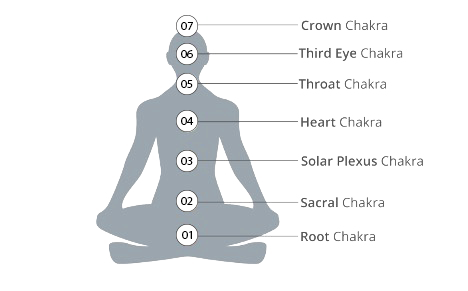
The 7 Chakras: Signs of Imbalance & Body Connection
Below is a reference guide to each of the seven chakras, their locations in the body,
and the signs that may appear when each is out of balance:
# |
Chakra |
Sanskrit |
Location |
Signs of imbalance |
|---|---|---|---|---|
| 01 | Root | Muladhara | Base of spine | Anxiety and fear, lower back pain, financial insecurity, sciatica, feeling unsafe, restlessness, constipation, weight fluctuation |
| 02 | Sacral | Svadhisthana | Lower abdomen, below navel | Low libido, hip tightness, creative blocks, emotional numbness, reproductive issues, guilt and shame, lower back pain, bladder issues |
| 03 | Solar Plexus | Manipura | Upper abdomen | Low self-worth, digestive issues, anxiety, control issues, chronic fatigue, indecisiveness, ulcers, aggression |
| 04 | Heart | Anahata | Center of chest | Grief and loneliness, heart palpitations, codependency, jealousy, upper back pain, shallow breathing, immune issues, holding grudges |
| 05 | Throat | Vishuddha | Center of throat | Fear of speaking, sore throat, thyroid issues, dishonesty, neck tension, poor listening, TMJ or jaw pain, over-talking |
| 06 | Third Eye | Ajna | Center of forehead | Headaches, poor intuition, eye strain, nightmares, mental fog, sinus issues, lack of focus, delusion |
| 07 | Crown | Sahasrara | Top of the head | Disconnection, closed-mindedness, spiritual apathy, migraines, loneliness, confusion, chronic fatigue, over-intellectualizing |
Working with the chakras is not about fixing what is broken — it is about restoring a conversation between your body and your deeper self. Reiki facilitates that conversation gently, and without words

Frequently Asked Questions
-
No. Reiki is a healing practice, not a religious one. It is compatible with any belief system — or none. People of diverse spiritual backgrounds, as well as those with no spiritual practice at all, find Reiki deeply meaningful and beneficial.
-
This varies by person and intention. Many clients notice meaningful shifts after a single session. For deeper or more sustained work — particularly for anxiety, trauma, or grief — a series of four to six sessions is often recommended. Your practitioner will work with you to develop a plan that feels right for where you are.
-
Yes. Distance Reiki is a recognized and widely practiced modality, rooted in the understanding that energy is not bound by physical proximity. Remote sessions follow the same general format as in-person sessions and many clients find them equally effective.
-
Come hydrated, wear comfortable clothing, and try to keep your schedule relaxed immediately after your session. There is nothing else you need to do or believe — simply arrive as you are.
book a session
To book a session or learn more, visit us at thrivemindhealthandholistic.com, call us at (917) 268-6556, or reach out at drgreen@thrivemindpsychiatry.com. We look forward to supporting you.